Saturday, April 12, 2008

Sad news: The death of Father Pax


This e-mail was sent by Father Michael Barton April 9, 2008:

Concerning the death of Father Raymond Pax, MCCJ. On March 31, 2008 in Saint Teresa Parish Rectory in Nyamlell, Aweil West County, Northern Bar el Gazal State in the South Sudan.

My name is Father Michael Barton, MCCJ and I am the parish priest of St. Teresa’s Parish and we have worked together for two years here.

I knew Ray since he was ordained a priest in 1965 and I was present and saw from a far his family and the black Cadillac and was impressed. As a seminarian I worked with Father Pax at St. Henry’s in Cincinnati, Ohio.

I want to begin on Easter 2008 when I came back after three months of safari pastoral visits to the chapels. Father Pax had been the whole of the Holy Week in the parish center and I was out.

On Easter Monday I began a teachers’ workshop and Ray went out with two boys to collect firewood for the course, and in the afternoon he prepared the Easter dinner with our cook Anthony and the Sisters came over for dinner together. Everyone got sick that night but me. The Sisters had to call the Slovak doctor to assist them.

By Tuesday Father Pax was also down with malaria but started to recover right away. On Wednesday we had a visit from Father Ireneo from Daeen in Darfur and he stayed the night.

On Thursday Father Pax took the car for a pastoral visit to Lueth Lual and Ariath Center to last four days and he went with Joseph as a helper in all . Father baptized about 70 people and had three marriages and some confirmations too. He had a general meeting with those catechists of the area and in four days visited five chapels.

He came back on March 30th and was quite happy and spoke of consolations during this past trip. As he was in his room after a light supper I went to tell him about his old friend’s and novice master’s death on the 12th of March in Milan and he thanked me for letting him know.

On Monday we had Mass together and breakfast and then had a planning meeting with the sisters to plan for the school year which was to begin on the next day.

Father Pax was strong in his opinions and criticisms of the past work and we came to many decisions for the new year’s work. We had agreed to meet later without the Sisters to see about our own Comboni matters.

I went to pay the part-time catechists and gave them some corn. The day before I had concluded and paid the teachers. Father Pax brought the chairs out.

At the end a catechist who had stopped his work demanded money of last year which had been stolen from my room because he had not come in December as he was told. He would not listen to any explanation of any type. I tried to give him some corn but he refused. Father Pax was not part of any of this but was in the office making out baptismal certificates for other catechists.

The African Apostles of Jesus arrived at the OLSH Sisters compound and I went to talk to them and could no longer deal with the angry catechist. I was told by Father Wilfred that the state authorities would not pay our teachers of our three Comboni schools because I was not cooperating WITH THEM.

Well I told Ray that I had to go to the state capital Aweil to see this matter and would go with the Apostles and come back with public means. He understood and said to go.

When I went back to our compound the catechist had taken the chairs and Father Pax had followed him on foot.

I left to Aweil and there the authority had changed his tune completely and all was very successful and clarifying. Father Wilfred took me to the bus park to get transport back to Nyamlell. I did not find any but Father Wilfred and Father Bernard came back and gave me their phone with a call from Father Colombo, MCCJ for me to go back to Nyamlell as the Sisters were frantic. The Apostles took me that Father Ray had collapsed and died. None of us could believe it. They agreed to take me back and I would give them diesel. We had a flat tire on the way. On arrival I found many people around the mission and the Sisters had dressed Ray in clerical shirt etc. and removed everything from his room to his office and his body was laying on his bed and Sr. Jeanne from Indonesia and Sr Jeviana from East Timor crying and praying.

They told me the bishop was coming and would take the body. I kept silence and waited. They had done a wonderful work and had been called latter as other people like those catechists were with him when he actually collapsed. They took over when the cook had called them.

Soon Bishop Caesar Mazzolari, MCCJ called me and said that he had talked to the family and to the Comboni provincial and that Ray was to be buried in Nyamlell. I gave the phone to Sisters so that could hear it from him. We agreed with the youth to dig the grave in the rectory compound as there is no cemetery in Nyamlell and Ray is the first priest or religious to die here even though this mission was started in 1933. I pulled the car over and turned on the lights so the youth could see to work. At 10:30 I celebrated the first Mass for Father in his room. We were three priest and three Sisters as the Gordhim Sacred Heart Sister who a former Superior General and many lay people. The sisters kept vigil the whole night. I had to get some sleep. We had already dressed him in priestly clothes.

The medical staff did what they could for him. We asked the Dutch NGO here if they make a coffin.

They woke me during the night to say the grave was ready and I moved and shut off the car.

On waking I went for my vigil; and prayer and then went to prepare the church and the readers and servers. At around 11 the coffin arrived from CORAID.

We put in the body and went in procession to the parish church. I was the main celebrant and gave the homily with Father Bernard adding more. About his life I said that Father Raymond Lawrence Pax was born In Celina Ohio on June 23rd, 1938 and was baptized at Immaculate Conception and had his primary education at Immaculate Conception School run by the Precious Blood Sisters and Fathers. He was number three of nine and three became priests. He had many uncles and aunts who had become priests and Sisters. Oscar was his father who was big into tools etc.

He went to Sacred Heart Seminary in Cincinnati run by the Verona Fathers for High School from1952 to 1956. He did his noviciate in Monroe, Michigan under Father Chiodi.He studied philosophy and finished college in 1961. He studied theology in San Diego, California. He was ordained a priest by Archbishop Karl Alter as the Combonis celebrated 25 years in the USA in May 1965 in Cincinnati at Sacred Heart Seminary.

He became an assistant pastor at Saint Henry and in California and back as pastor at

Saint Henry in Cincinnati’s old west end.

Around 1970 he came to Africa to Uganda where he worked in several MISSIONS in Gulu diocese among the Acholi.

Aronnd 1975 he was transferred to Kenya and worked mainly in Kasikeu and before that in Gigil. He also worked in the USA in California in pastoral work and then he came to Sudan. He worked in Juba and then in Tambora diocese and a few months after being expelled from Juba in Khartoum and finally in Rumbek diocese where he worked various years in Marial Lou, then in Mapuordit and at last here in Nyamlell.

There were five speeches after the Mass and the Commissioner declared Father Pax to be a Dinka and three days latter had a bull killed in his honor and people gathered for that too. After Mass we went in precession carrying the coffin to the grave where we had the final prayers. The coffin was too big so more digging and adjusting took place. Everyone stayed until the burial was complete and the Sisters had made paper flowers which we spread all over the grave.

Father Pax’s work has just begun to help the Dinka people and this mission and all its people and work.

Wednesday, March 5, 2008

School crowd welcomed return of Father Michael


This letter was sent by Father Michael Barton from St. Teresa Parish in Nyamlell to Jane Lichtenberg, arriving in late February:

Dear
Jane,
I got back here in mid December and a big crowd was waiting for me at the airstrip and accompanied me back to the mission. I had to leave one bag in Nairobi and another in Loki and I came with 33% of my luggage. I hope I shall meet the other 66% someday in the future.

I helped in the next days with the final examinations and tested the catechumens and then it was Christmas. As it had rained very much while I was away and there had been a big flood and the River Lol was still too high for a car to pass, Fr. Pax stayed in the center parish and I went out by bicycle to Gok Macar. We had midnight Mass under the stars with the shepherds, and then in the morning many confessions and testing of the candidates and catechumens and had baptisms and confirmations during the Mass and 111 infant baptisms after the Mass. Then we went to another chapel for another round of testing, Mass, baptisms and confirmations and another 80 infant baptisms.

Those last infant baptisms were done at night with a flashlight. They all have now seen how fat I have become and so maybe that is why the only meal I was given was some rice when all the sacramental and liturgical work had been finished. I went back with the flashlight to fall exhausted on my sleeping bag for the night.

The next night was in Adhal halfway between Gok Macar and Nyamlell where we had another huge crowd and testing, confessions and Mass and confirmations and 130 infant baptisms. Finally, I got home and we had a little Christmas celebration between Ray and me.

I have been out every day since then to different chapels and with fewer people but always a lot of work. While I was out someone got in through the window of my room and stole money and ransacked an already messy room. I think that was the second time it happened. They did not find where I had hidden the big money but even the little money would have been very useful.

The SPLA government has improved the roads going to the state capital Awiel and has taken more of the mission land.

I was supposed to go to Rumbek for a diocesan assembly but the others left me behind in Awiel and so I have some time to answer letters and correspondence. On my way back from Awiel I found a very old man walking with a cane and with a 50-cent hat on and a 50-cent shirt on.

The building of the four classrooms is going on well but well behind schedule. Now with all the trouble over the fraudulent elections, supplies coming from Kenya have all but stopped. Also, the NGO who is building them with my money has Internet (access) and I shall try to use it once a month or so.

On Ash Wednesday I will go to more chapels and will be out for most of Lent. March 24 will begin a teachers course and then a new school year.

Pax vobis cum. Father Michael D. Barton

Tuesday, December 25, 2007

New Internet blog serves as resource for Comboni Father Michael Barton’s work in Sudan


This article appeared in The Criterion Dec. 21, 2007

By Mary Ann Wyand

Comboni Father Michael Barton’s prayers and his Christmas wish list begin with peace and an end to violence for war-torn Sudan.

He also hopes for donations to build a church and school in the village of Marial Baai within St. Theresa Parish in Nyamlell, where he serves as pastor.

Catholics in central and southern Indiana can learn more about his ministry half a world away in southern Sudan by logging on to a new Internet site created by Jane Lichtenberg, a member of Holy Spirit Parish in Fishers, Ind., in the Lafayette Diocese. The weblog address is www.nyamlell.blogspot.com.

As Community Conversations coordinator for The Indianapolis Star, Lichtenberg has written about the Comboni priest’s ministry.

Father Barton grew up in Indianapolis, and has served the Church as a missionary priest in Sudan from 1978 until 1986 then from 1993 to the present.

When Lichtenberg talked with him during his home visit last summer, she learned that he is trying to raise funds to build church and school buildings in a village in Northern Bar el Gazelle State.

She decided to create the blog to keep people informed about his ministry and pastoral needs. It includes excerpts from his letters as well as stories about his ministry that were published in The Indianapolis Star and The Criterion.

Lichtenberg launched the site in September after Father Barton departed for a sabbatical in the Holy Land on his way back to East Africa. He arrived at his parish in Sudan on Dec. 10.

In an e-mail to The Criterion, she requested publicity for the new blog.

“He has spent the past five years based in Nyamlell, another village in the parish,” Lichtenberg explained. “From there, he has traveled hundreds of miles visiting other parts of the parish, administering sacraments and spreading God’s Word to the Sudanese people, many of whom live in great poverty.”

She said his goal is to raise $150,000 for a church and school at Marial Baai.

“I suggested a blog that would help him keep in touch with his many friends in the Indianapolis area and around the world, and tell people how he would use donations and where to donate,” she said. “Although when he is in Sudan he has no access to computers or the Internet, I asked him to write letters, and have another priest in the parish write as well, to keep all of us up to date on his mission.”

Citing “the extraordinary work he has done in South Sudan,” Lichtenberg said she plans “to continue managing the blog for him, and hope that people who visit the Web site will take time to write comments and include their own thoughts about this extraordinary man and his mission to Sudan.”

During an interview with The Criterion last August at the archdiocesan Mission Office, Father Barton talked about answering God’s call to serve the people in Sudan 30 years ago.

Saving souls for God is his first priority as a missionary, he said, and educating the children is a close second.

At the Catholic schools he established in St. Theresa Parish, children study English, Dinka, Swahili, Arabic, science, agriculture, geography, civics, history and Christian religious education, including the Gospels and the Acts of the Apostles during the last three years of school.

While ministering in Sudan for three decades, Father Barton has been sick with malaria, was imprisoned for 15 days in August 1996 and had to kill a poisonous snake at the parish last year.

That is all part of serving God’s people in Sudan, he said. “I just have to do something.”

(For more information about how to help Comboni Father Michael Barton with his missionary work in Sudan, call the archdiocesan Mission Office at 317-236-1485 or 800-382-9836, ext. 1485.)

Tuesday, December 4, 2007

Mount Sinai on Thanksgiving Day

A e-mail note from Father Michael from the Holy Land, Nov. 26:

On Thanksgiving Day 2007 we as secessionists went up to Mount Sinai. We got up at 2 am and started up the mountain at 3 am. The day before we went Jerusalem at 5 am and visited Mitzpe Ramon, which was a wonderful lookout in another wonderful view of the mountains and plains of the Israel desert and then down to Eliat and we crossed the border at Taba and the Egyptian Comboni Sister got turned back and the Ethiopian priest make it but had to take a lot of stuff from both sides. We were at the border for three hours.Then we drove on the shore of the Gulf of Aqaba and then up the high plateau in the Wadi Ghazala to Wadi el Sheikh.
Thursday November 22nd, we took a bus to Saint Catherine's Monastery and started the ascent up "Jebel Musa" along the Sikket-el-Basha path and we all walked even though there were camels available which took two hours and then straight 743 steps to be there for sunrise. The sun make it but not everyone else. I used a flash light and did make it. With Moses in mind I thank God for his revelation and even his commandments and the view of the mountain tops was just something outstanding.
Then down the 743 steps and them down the traditional Moses' path of some 2000 more steps and a few falls. It was day now but still tough, very hard on my knees.
Once we all got down we had Mass outside on the mountain side. and then we went in to the Orthodox of the historic Saint Catherine's Monastery and then lunch and went on a short desert walk up to the Rock of Inscriptions of many travelers and the graffiti left by them. We spent the America Thanksgiving Day on the Gulf of Aqaba or the Red Sea. I was tired indeed.
The next day we crossed the borders with no problem at all and we stopped to see the coral reef and the Eilat Aquarium. Then we went by bus to visit the Timna natural reserve and Solomon's Columns, the Temple of Goddess Hathor, which was an ancient copper smelting installation done by the Egyptians.
We got back to Jerusalem after dark and got woken up by another earthquake around the Dead Sea. No harm done.
On Saturday evening we started an eight day directed retreat and will be till Sunday December 2nd midday.
I may go to Jordan on the fifth till the ninth and on the tenth I head back to Africa.
Michael

Thursday, November 22, 2007

A note from Fr. Michael before leaving for the Holy Land, September 2007


This letter was written while Father Michael Barton was on sabbatical in Indiana during the summer of 2007:

In a few days I leave for Chicago and then London and then Tel Aviv and then Jerusalem where I shall stay for close to three months for some on-going formation in a course organized by the White Fathers. After the course in early December I shall be back in the Sudan.
The last five years have seen the rectory, the church, dispensary, the convent and 17 classrooms, and a compound for medical workers and another compound for a Dutch non-governmental organization of Charitas International repaired after 40 years of neglect. There has also been an upgrade of the dispensary to a tuberculosis hospital, all in Nyamlell. Three schools have gotten off the ground and the results of the grade eight standardized testing put Nyamlell in first place of the 13 primary Comboni schools run by the Catholic diocese of Rumbek.
From the point of view of pastoral work I had around 9,000 baptisms and 2,000 confirmations and several hundred marriages. Most of this has been in a time of war and very fragile peace.
War has had its problems but peace also has its problems. There was a signed peace agreement on Jan. 9, 2005, and the rebel movement took over the government of South Sudan. So the situation is in flux for the better for the most part but sometimes for the worst.
This year we have once again started the first year of Sacred Heart High School. We also got another priest and three religious sisters to join the pastoral team. The father is a Comboni Missionary from the Buckeye state and the sisters are from Indonesia. God has blessed us and the work is His and we thank you for all the sacrifices that you have made to help us up to now.
Later I will begin my second half of the year and still need more help than ever in continuing what was started up to now and to do more in the next five years. During this time there is need of building some permanent classrooms in Marial Baai and to build some permanent church buildings in the most important parts of the parish. This is all going to take a lot of funds and work. There I appeal for your help and prayers. Many thanks and many blessings on you.
Yours in the Heart of the Good Shepherd,
Michael D. Barton

Notes from Jerusalem -- Father Michael Barton

These e-mails were sent to Jane Lichtenberg in Indianapolis from Father Michael during his trip to Israel September-November 2007:

Sept. 17
I got to Chicago and then to London all without many problems. I arrived in Tel Aviv on Wednesday and the White Fathers had sent on a car and driver and that is how I got to Jerusalem. The next day was the Jewish New Year and also the first day of Ramadan.They put up colored lights and special foods were being sold in just about every shop.Then there were throngs of people of Islamic belief heading to the Golden Dome for afternoon and evening prayers and Jews going to the Wailing Wall and soldiers everywhere to make sure all could be controlled. During the day lots of Christian pilgrims on the Via Dolorosa making the Way of the Cross and making their way to Calvary and the tomb all in the church of the Holy Sepulcher and it is fascinating to see so many Christian Rites and Traditions all in one church Orthodox and Catholic at the same time.
Here we are 17 doing the course all missionaries who have worked in Africa and four and Sisters and the rest are priests, all from many different nationalities. We are right at the birthplace of Mary and at an excavation of the pool where Jesus cured in John 5. So it is really neat and exiting place.

Oct. 6:
I am glad to tell you all is great with the classes and the group work and the visits to all the Holy sites in Jerusalem and this week I went twice to visit Bethlehem, once by myself and another with all the sisters, brothers and priests who are in the sessions with me all missionaries who had worked or who are working in many countries of Africa. One is from Canada and one from Egypt and another from Ethiopia and the rest from European countries. This week we had religious plurality all week as a theme.
I love visiting the Holy Sepulcher and my group said Mass on Calvary on day and then in the Tomb another. I prayed for you both times and so many more. We were in the tomb for Saint Therese of the Child Jesus day. I enjoyed walking the narrow streets of the old Jerusalem and practicing my very broken Arabic. I also enjoy going to the wailing wall and watch the Jews pray. We are very near and go any time. However we can only go to the Rock of the Dome or Temple Rock when the Muslims allow us which is for two hours on Sunday when they are not praying. I also go to Gethsemame very often.
Going to Bethlehem by myself was very different than with our group because I had to pass the check point which was full of bared wire and high walls and soldiers. As a group we were allowed to just drive through.
I think Jerusalem can help some people's faith and of course can do just the opposite to others. To me it is great and I love the Russian Orthodox churches and monasteries an the are very beautiful and unusual.


Oct. 22:
I am getting near to my half way mark to my stay in Jerusalem. Last week we talked about the theme of the Kingdom of God. We got to Qumran and two Orthodox Monasteries and one or them was the Church of the Temptations of Jesus. This week we were about to meet some hierarchy of the Armenian and Greek Orthodox Churches and we even went for a float (as it is difficult to swim) in the Dead Sea which they say is the lowest part on the earth. It was fun but the water hurt my eyes and nose terribly. Today I went to two Synagogues for the Sabbath services and tonight I will go and get lock in the Church of the Holy Sepulcher and tomorrow we will all go to Galilee for the entire week. One of the priests from our group was found to have cancer of the colon and so left the Sessions to go to his home in Barcelona, Spain for treatment and has already been operated on and they want to make a map of his liver to treat the spots as best they can.It was bad news to all of us.

Nov. 10:
We had a wonderful week in Galilee. We spent the nights in guest house in Nazareth but the days were out in many holy sites and archaeological digs. We left on a Sunday and came back on Friday evening. On Sunday we stopped at Caesarea on the Mediterranean Sea and saw a set up built by Herod the Great that looks like the race track out of Ben Hur and then to the Biblical site of Armageddon (Megiddo) and then to Haifa and the very wonderful and beautiful Bahais' Garden there. On Monday we went to Capharaum and Koorazim and the Church which commemorates the multiplication of the loaves. On Tuesday we stayed the whole day in Nazareth and it was wonderful to spend time in the Home of Mary and other churches there of different rites and traditions. Wednesday took us to Dan and the Golan Heights and ended on the Mount of Beatitudes near Lake Galilee. Then on Thursday we climbed on foot to the top of Mount Tabor where we had the Eucharist and I met a man who I knew in the Sudan and afterwards we went to Cana where the first miracle took place. A boil slowed my walking but even the slowest and the last make it in the end. Friday was neat as we had Mass at the Primacy of Peter on the Lake of Galilee and the a boat ride on the Lake and that was followed by a visit to some Roman ruins which are very well k ept and explained at Bet Shean and finally a visit to the very creek like Jordan River and a swim in a Russian Kibbutz and the return by way of the Jordan valley.
This week we have treating the topic of Justice and Peace and Integration of Creation which I am a bit weak in.
In four weeks I will be back in Africa.
Michael

Embracing mission in warn-torn Sudan


These two articles appeared in October 2007 the Criterion, the newspaper of the Archdiocese of Indianapolis
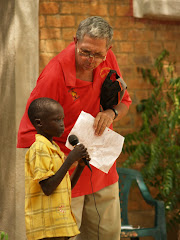
Photo at right: Father Michael Barton and young man from St. Theresa Parish.

Comboni Father Michael Barton embraces mission work in war-torn Sudan

(Editor’s note: “Stewards Abroad” is an occasional series that reports on the missionary efforts of Catholics from the Archdiocese of Indianapolis throughout the world.)

By Mary Ann Wyand

Violence continues daily in the Darfur region of western Sudan, where United Nations officials estimate that more than 200,000 Sudanese people have been killed and at least 2.5 million displaced during four years of a bloody holy war waged by Muslim extremists.

On Oct. 11, the country’s 2005 Comprehensive Peace Agreement, which ended a 21-year civil war, was threatened when the Sudan People’s Liberation Movement withdrew cabinet members representing southern
Sudan from participation in the central government.

Comboni Father Michael Barton, who grew up in St. Therese of the Infant Jesus Parish in
Indianapolis, returned to Sudan in September following a home visit and mission trip to El Salvador last summer.

During an Aug. 7 interview at the archdiocesan Mission Office at the
Archbishop O’Meara Catholic Center in Indianapolis, Father Barton talked calmly about the continuing violence in Sudan and enthusiastically about his mission work at St. Theresa Parish and four Comboni schools in Nyamllel in southern Sudan.

Catholics in central and southern
Indiana are invited to pray for missionary priests, sisters, brothers and laity serving the Catholic Church throughout the world during the archdiocesan World Mission Sunday Mass at 2 p.m. on Oct. 21 at SS. Peter and Paul Cathedral,

1347 N. Meridian St., in Indianapolis. Msgr. Joseph F. Schaedel, vicar general and director of the Mission Office, is the principal celebrant for the Mass.

Father Barton and Father Alfred Loro Caesar, a diocesan priest and seminary rector in the Archdiocese of Juba, met with Sister Demetria Smith, a Missionary Sister of Our Lady of Africa and the archdiocesan mission educator, on Aug. 7 to discuss the Church’s tenuous situation in Sudan and ways that Catholics in central and southern Indiana can support their missionary work.

Father Barton has served in
Sudan from 1978 until 1986 and from 1993 to the present so he understands the volatile political and religious conflicts that plague the impoverished East African country.

“The Church in
Juba is serving the people in a very trying time,” Father Loro said of his home diocese. “Many people have been killed. The whole world knows about it. I think it is worse than the former [civil] war. … We have so many orphans that we have baptized.”

Father Loro said he believes the United Nations’ statistics on the number of people who have been killed, displaced or died of malnutrition and diseases in recent years are too low.

Sudan has been torn apart by civil war since 1984. During the 21-year conflict, more than 2 million people have died from the fighting and starvation.

“The Church in
Sudan has been the target of Muslim radicals,” Father Loro explained. “Because of this, the Church has been weakened. They are trying to bring down the whole Church, but I think that could not happen. I have been speaking about the needs of the Church [in Sudan] right now because we lost many things [due to the fighting]. Churches and schools in Juba were destroyed. They want the whole country to be Muslim.”

He said Catholic priests, religious and laity in Sudan educate the people in the faith, teach the children, help bury the dead, shelter and feed displaced and starving survivors, advocate for justice and work for peace.

“The Archdiocese of Juba is right in the very center of the bloody Sudanese conflict,” Father Loro said. “Our clergy, religious and laity [who are] catechists, although they are prime targets of Muslim extremists, are

nevertheless fighting against all odds to keep the flames of our Christian faith burning brightly in our country. … We continue to witness to Christ’s Gospel of peace, love and mercy, serving all our traumatized, desperate people, Muslims included. The Church remains the only voice of reason, the only hope for our people.”

Father Barton loves
Sudan, has spent much of his life there, and wants to continue to help the people grow in their faith and educate the children.

“It’s a very poor life,” he said. “Sorghum, a grain, is the main food in
Sudan. Then the people have to carry water [to their homes]. It’s always a struggle to survive. So many enemies, so many difficulties, make life very hard.”

His current assignment at St. Theresa Parish in Nyamllel was a mission started in 1933, but the buildings were damaged by fighting and weather during the civil war, and the rubble was left vacant for decades.

When Father Barton arrived in Nyamllel for the first time in 2002, he was the first resident priest to minister to the Dinka people there since 1964, when the Arab government in the north expelled all the Catholic and Protestant missionaries from
Sudan.

He said the previous missionary priest and brother assigned there were attacked during the night and had to flee for their lives wearing only their underwear.

“They were left with nothing, no passport, not even their pants,” he said. “They had to escape by running and left everything they had there.”

Nyamllel isn’t the first place where Father Barton has relied on God to start a new ministry with few resources.

When he began his previous mission at Mapuordit in southern
Sudan in 1984, he opened a Comboni grade school with 125 children. Eighteen years later and with God’s help, he said, 2,000 students were enrolled at two Comboni grade schools and a secondary school in Mapuordit when he went to Nyamllel in 2002.

During five years at Nyamllel, Father Barton said he has “worked a lot repairing the buildings and getting the school going. We now have three Catholic grade schools there. One school has about 370 students and the other about 350 students, up to class eight. The third school has just 50 children, only class one, two and three. [The schools] feed into
Sacred Heart High School.”

On weekends, Father Barton takes turns celebrating Mass at 80 chapels in the Diocese of Rumbek.

“My goal, and what I have been able to do these last five years that I’ve been there, is to celebrate Mass twice a year at each chapel,” Father Barton said, because another Comboni priest helps him with Masses at St. Theresa Parish.

“Now I have more freedom to go out to the chapels more often,” he said. “Last year, we had 1,859 baptisms in the diocese. This year, from Jan. 1 to when I left Nyamllel right after Easter on April 10, we already had over 1,100 baptisms.”

When he arrived in
Sudan in 1978, Father Barton said there was an average of two marriages per diocese in Sudan. Now there are more priests and more marriages.

“Every once in a while, I can get some of the parents to have their marriage blessed in church,” he said. “That thrills me. When I can bless a marriage, I always think God is patting me on the back. And not only

marriages, but some of the children will become priests. That’s all very encouraging.”

(For more information about how to help Comboni Father Michael Barton with his missionary work in
Sudan, call the archdiocesan Mission Office at 317-236-1485 or 800-382-9836, ext. 1485.) †

Mission priest inspires vocation in young man he baptized in 1979

By Mary Ann Wyand

With God, all things are possible.

Comboni Father Michael Barton, a native of
Indianapolis who has served the Catholic Church in southern Sudan as a missionary priest from 1978 to 1986 and from 1993 to the present, believes that but admits that God still surprises him.

Last summer, Father Barton met a Sudanese man that he baptized as a 6-year-old boy during a missionary visit to the
Bari village of Yaro in 1979.

Now 33, the man is a diocesan priest for the Archdiocese of Juba, but they didn’t meet in
Sudan or even in Africa.

While he was home for a family visit, Father Barton met Father Alfred Loro Caesar at St. Pius X Church in Indianapolis when the Sudanese priest was making a mission appeal during weekend Masses there in August.

It’s hard to imagine, Father Barton said, that he would meet one of the tens of thousands of Sudanese children he has baptized—during 22 years of missionary work in Africa—half a world away in his own hometown.

But then again, he said, smiling, God works in amazing ways.

“I was 6 years old when I was baptized by him in my own village,” Father Loro said during an Aug. 7 interview at the archdiocesan Mission Office at the
Archbishop O’Meara Catholic Center in Indianapolis.

“That is all I can remember,” Father Loro said. “Our village is not far from the parish where he served among the
Bari [people]. He even taught me a little English.”

Father Loro attended a Comboni grade school as a child and was confirmed in the Church, but had to flee from Yaro to
Juba in 1988 because of the civil war in southern Sudan.

“He suffered during the war,” Father Barton said. “It was very difficult for the boys. He had to run away to many places. He had to flee for his life several times.”

Father Loro entered the seminary in the Archdiocese of Juba and was ordained in 2005.

During his mission appeal visit to the
U.S. last summer, Father Loro preached at Masses at Catholic churches in Connecticut, Delaware and Indiana.

“We met when he was baptized in 1979,” Father Barton said. “The first time I am able to concelebrate Mass with him is … in my own hometown.”

Their unexpected reunion was amazing, Father Loro said. “I told him he inspired me very much. … I found my way to the seminary.”

Now Father Loro serves as the rector of the minor seminary in the Archdiocese of Juba, where 75 young men are studying for the priesthood this year.

In his mission talks, Father Loro shares the good news of the Church in
Sudan

and recounts horrifying statistics from the 21-year civil war that ended in 2005 and the current holy war waged by Muslim extremists in the
Darfur region of Sudan.

Despite this new conflict and threats to the Jan. 9, 2005, peace accord, Father Loro and Father Barton recently returned to Sudan to serve God’s people as best they can in the wake of continuing violence there.†